*This post may contain affiliate links for which I earn commissions.*
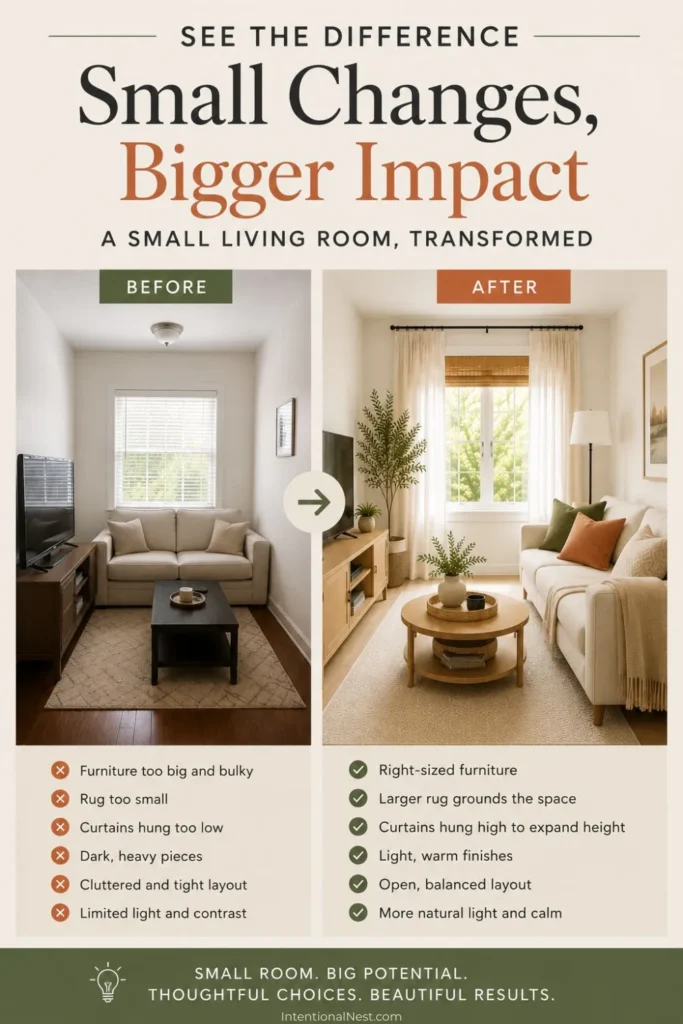
A small living room can still feel bright, comfortable, and beautifully put together. The secret is not removing everything you love. It is making a few thoughtful choices about layout, furniture, light, color, and storage.
A small living room can feel frustrating to decorate.
You want it to be comfortable, but you do not want the furniture to overwhelm the space. You want it to feel warm and personal, but too many decorative pieces can quickly make the room look crowded. Even simple choices, such as rug size or curtain height, can have a bigger visual impact than you might expect.
The good news is that you do not need a full renovation or an entirely new set of furniture to make your living room feel more spacious.
Often, the biggest improvements come from changing the layout, choosing pieces with less visual weight, improving the lighting, and giving the eye more room to move around the space.
The goal is not to make your living room look empty. It is to help it feel lighter, calmer, and easier to use.
Here are seven practical ways to make a small living room look and feel bigger.
At a Glance
To make a small living room feel more spacious:
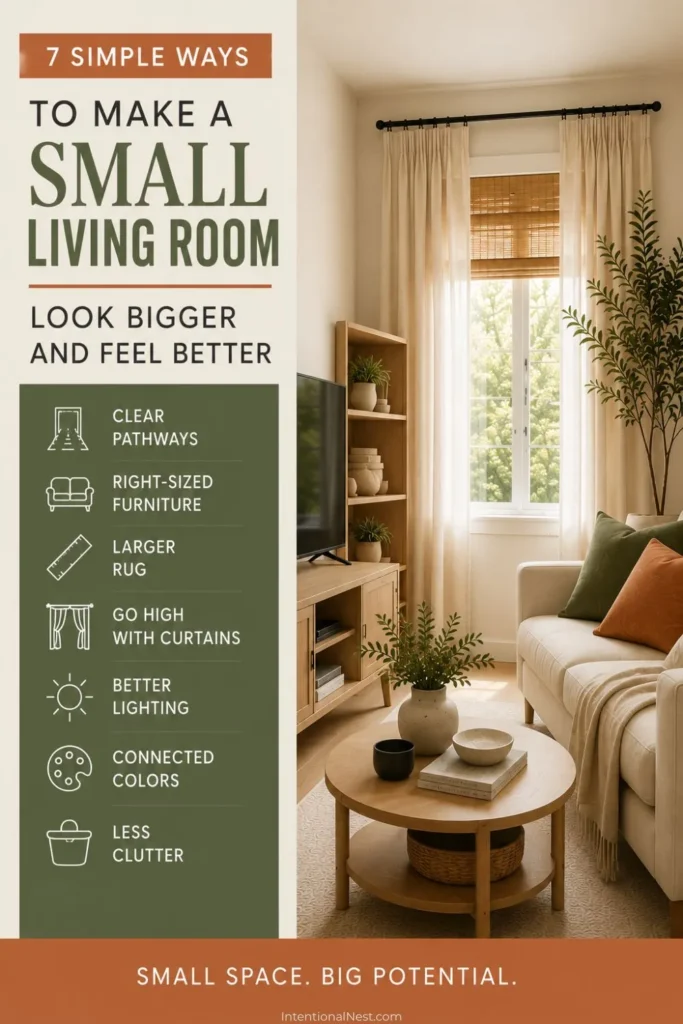
- Create clear pathways through the room
- Choose furniture with less visual weight
- Ground the room with a generously sized rug
- Draw the eye upward
- Make good use of light
- Keep the color palette connected
- Reduce visual clutter without removing personality
1. Create Clear Pathways Through the Room
Before you buy anything new, take a close look at how you move through the room.
Can you walk from the doorway to the sofa without stepping around a side table? Is there a clear route to the window? Do you have to squeeze between the coffee table and the chair?
When movement feels awkward, the room usually feels smaller too.
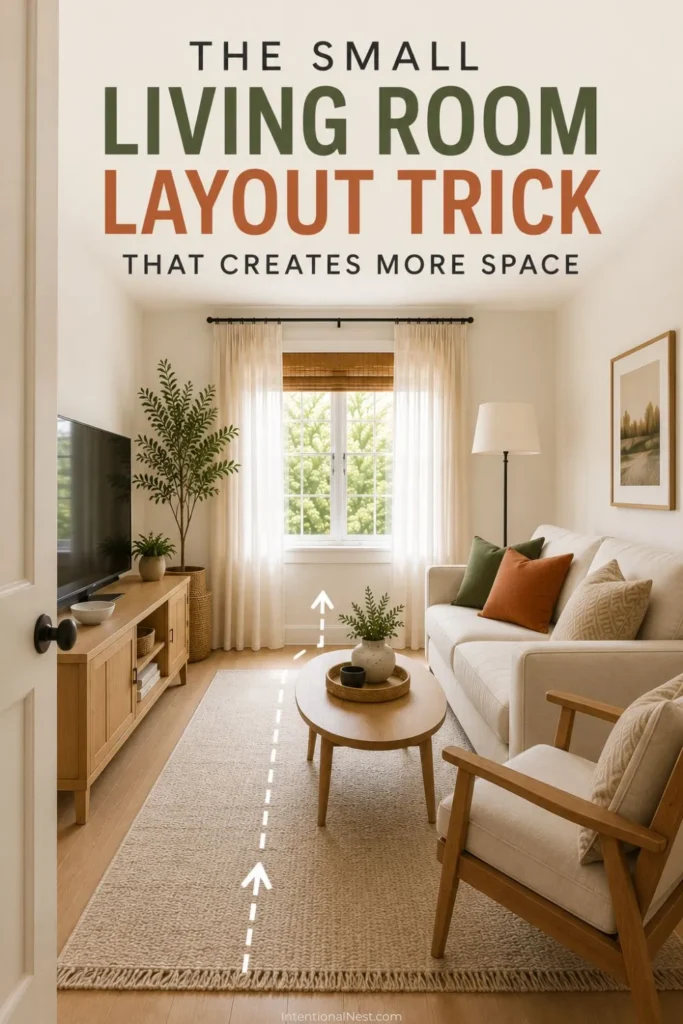
Start by identifying the main pathway through the space. In most living rooms, this is the route from the doorway to the sofa, window, or adjoining room.
Try to keep this pathway open and easy to follow.
Sometimes, moving a chair by a few inches is enough to make the room feel better. In other cases, you may need to remove a small table, relocate a floor lamp, or change the position of the sofa.
It is also worth questioning the idea that all furniture must sit against the walls. For suggestions on the best layout for your small living room, check out our layout guide.
Pulling the sofa forward slightly can sometimes create a more balanced seating area. It may also give you enough room for a slim console table, a floor lamp, or hidden cable storage behind it.
A small living room often works better with fewer useful pieces than with several small items placed around the edges.
Try this first
Stand in the doorway and take a photograph of the room.
A photo can help you see the layout more clearly. Look for furniture that blocks the view, narrow walkways, and crowded corners.
The first piece that catches your eye for the wrong reason is often the best place to begin.
Product suggestions
Look for products that support a clearer layout:
- A narrow console table that can sit behind the sofa
- A small round or oval coffee table
- Nesting side tables that can be moved when needed
- A wall-mounted shelf instead of a freestanding cabinet
- A slim floor lamp with a small base
- A storage ottoman that can replace both a footrest and an extra table
Choose pieces that serve more than one purpose whenever possible.
2. Choose Furniture With Less Visual Weight
A piece of furniture can be physically small and still look heavy.
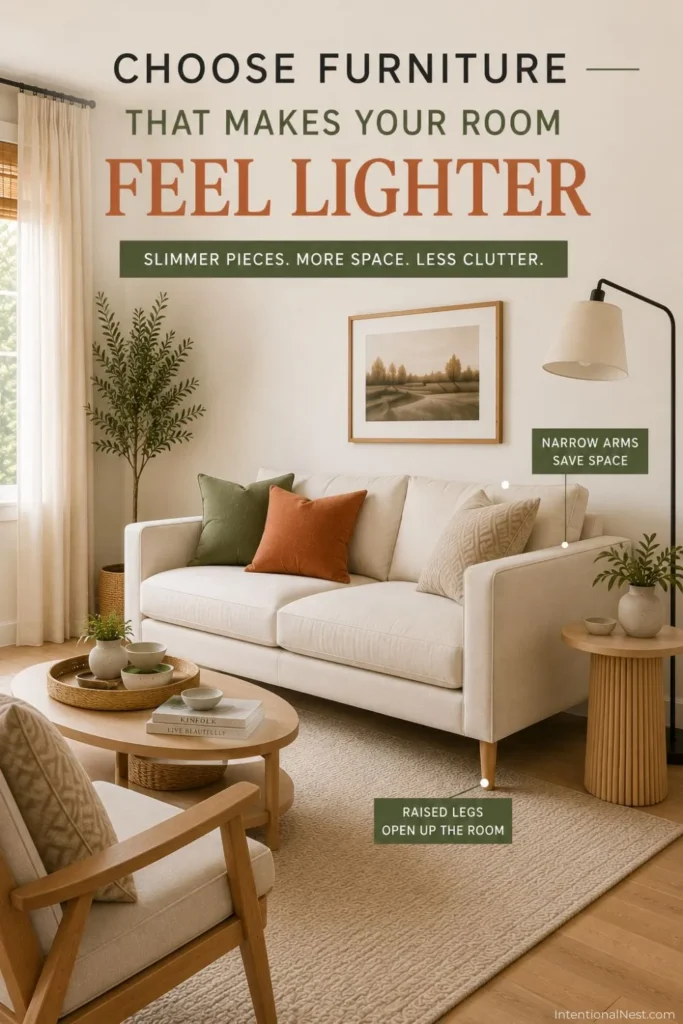
A compact sofa with wide arms, a low solid base, and dark upholstery may dominate the room. A slightly longer sofa with slim arms and visible legs may look lighter and take up less visual space.
This is why it helps to think about visual weight, not just measurements.
Furniture with open space underneath allows more of the floor to remain visible. When you can see more floor, the room often feels less crowded.
Look for furniture with:
- Raised legs
- Slim arms
- Open frames
- Rounded corners
- Simple shapes
- Light or medium wood tones
- Glass, cane, or woven details
You do not need to choose tiny furniture for every part of the room.
In fact, filling a compact living room with several undersized pieces can make it feel busy. A comfortable sofa and one well-placed accent chair may look calmer than a small sofa surrounded by stools, extra chairs, and side tables.
The most useful question is not, “Is this piece small?”
Ask, “Does this piece look light, fit the room, and serve a clear purpose?”
Product suggestions
When shopping for a small living room, consider:
- A two-seat or apartment-size sofa with narrow arms
- A sofa raised on wooden or metal legs
- An open-frame accent chair
- A round pedestal side table
- A glass or light-wood coffee table
- A small oval coffee table with rounded edges
- A storage ottoman with a removable tray
- A wall-mounted reading light
Rounded furniture can be especially useful in narrow rooms because it is easier to move around and softens the hard lines of the space.
3. Ground the Room With a Generously Sized Rug
One of the most common mistakes in a small living room is choosing a rug that is too small.
It may seem logical to use a small rug in a small space, but the opposite is often true.
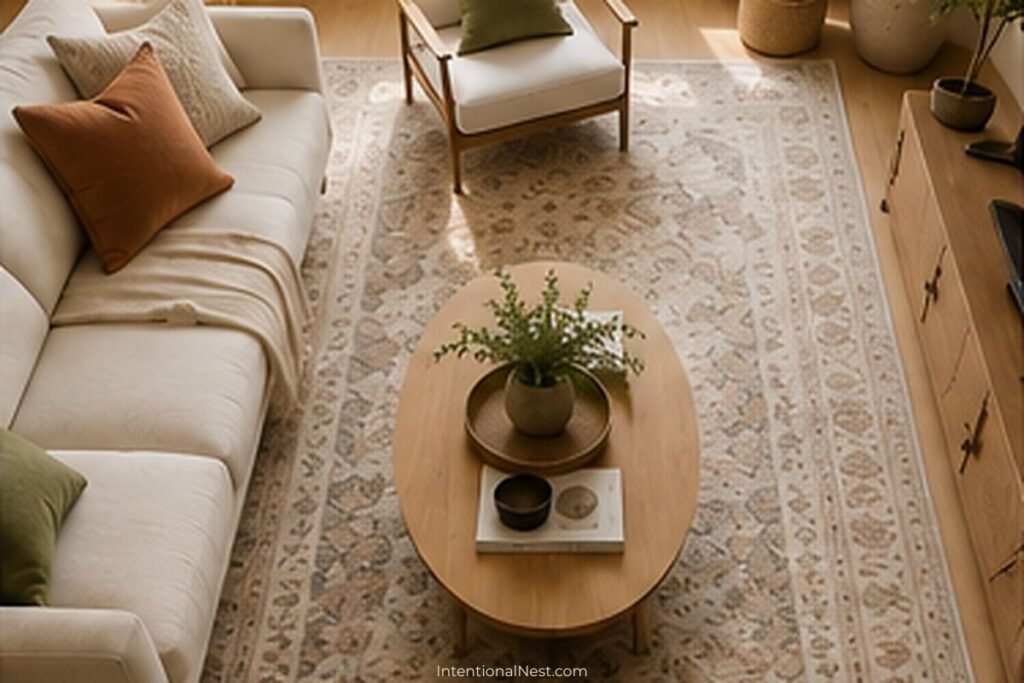
When a rug sits only beneath the coffee table, it creates a small island in the center of the room. The sofa, chairs, and surrounding floor feel disconnected.
A larger rug brings the furniture together and makes the seating area feel like one complete zone.
Ideally, the front legs of the sofa and chairs should sit on the rug. In a very compact room, you may be able to place all of the furniture on it.
The rug does not need to be bold or highly patterned. A subtle pattern, soft stripe, or natural woven texture can add warmth without making the room feel busy.
Try to avoid a rug with a strong contrasting border. It can visually frame a smaller area of floor and make the room feel more restricted.
Product suggestions
Good rug options for a small living room include:
- A low-pile wool rug
- A washable flatweave rug
- A soft neutral rug with a subtle pattern
- A jute or jute-blend rug
- A tonal geometric rug
- A lightly textured rug without a dark border
For most small living rooms, an 8-by-10-foot rug often works better than a 5-by-7-foot rug, although the final size will depend on your room and furniture placement.
Before ordering, mark out the rug dimensions on the floor with painter’s tape. This makes it much easier to see whether the rug will connect the furniture properly.
A note on shape
A rectangular rug works well in most rooms, but it is not your only choice.
An oval rug can soften a narrow room and make it easier to move around the coffee table. A round rug can work well in a square space, reading corner, or small conversational seating area.
4. Draw the Eye Upward
When you cannot add more floor space, make better use of the walls.
Vertical elements encourage the eye to move upward. This can make the ceiling appear higher, and the room feel more open.
Curtains are one of the easiest ways to create this effect.
Instead of placing the curtain rod directly above the window frame, hang it several inches higher. Position the rod as close to the ceiling as possible.
Extend the rod beyond the width of the window too. This allows the curtains to sit mostly outside the glass when open, which exposes more of the window and lets in more natural light.
Floor-length curtains usually create a more polished look than short curtains that stop below the sill.
The long vertical line helps the window appear taller and gives the room a stronger sense of height.
You can also draw the eye upward with:
- A tall, narrow bookcase
- A slender floor lamp
- Vertical artwork
- High wall shelves
- A tall indoor plant
- Wall paneling
- Subtle vertical stripes
- A floor-to-ceiling mirror
Try not to place everything at the same height.
If the sofa, artwork, lamps, and shelves all sit around the middle of the wall, the room can feel visually compressed. Varying the height gives the space more movement.
Product suggestions
Consider adding:
- Ceiling-mounted curtain tracks
- Extra-long curtain panels
- A tall ladder-style shelf
- A narrow bookcase
- A vertical framed print
- A slim full-length mirror
- A tall planter
- An arched floor lamp
Choose curtains that are close to the wall color for a softer, more continuous look.
If the curtains strongly contrast with the walls, they may divide the room visually. That can still work, but a lower-contrast combination usually feels calmer in a small space.
5. Make Light Work Harder
A brighter living room often feels larger, but adding a stronger ceiling light is not always the answer.
Start by making better use of the natural light you already have.
Avoid placing bulky furniture directly in front of the window. Even a low chair can reduce the amount of light entering the room if it sits too close to the glass.
Keep curtains easy to open during the day. Sheer curtains are useful when you want softness and privacy without blocking too much light.
If you need more privacy, pair sheers with a simple roller blind or Roman shade that can be raised during the day.
Use mirrors thoughtfully
A mirror can reflect light and add depth, but the placement matters.
Try to position it where it reflects a window, a bright wall, or an attractive part of the room.
Avoid hanging a mirror where it reflects clutter, a television, or a busy storage area. A mirror does not automatically make a room look bigger. It enlarges whatever it reflects.
Before hanging it, stand where the mirror will go and look at the opposite side of the room. That is the view you are about to duplicate.
Layer the lighting
One ceiling fixture often leaves the corners of a room feeling dark.
Instead, use several smaller light sources around the room.
You might combine:
- A ceiling light
- A floor lamp beside the sofa
- A wall-mounted reading light
- A small lamp on a console
- A picture light above artwork
This spreads the light more evenly and creates a softer atmosphere in the evening.
Warm bulbs usually make a living room feel more comfortable. Choose bulbs with a consistent color temperature so the room does not look yellow in one corner and cool in another.
Product suggestions
Useful lighting products include:
- A plug-in wall sconce
- A slim tripod floor lamp
- An adjustable reading lamp
- A small ceramic table lamp
- A round or arched wall mirror
- A full-length leaning mirror
- Sheer linen-look curtains
- A light-filtering roller shade
Plug-in sconces are particularly useful if you want wall lighting without hiring an electrician.
6. Keep the Color Palette Connected
You do not have to paint your small living room white.
Soft greens, warm neutrals, muted blues, clay tones, and even deeper colors can work beautifully in a compact space.
The more important consideration is how the colors relate to each other.
When the walls, curtains, large furniture, and rug have similar undertones, the eye moves more easily around the room. Strong contrasts can break the room into smaller visual sections.
This does not mean everything needs to match.
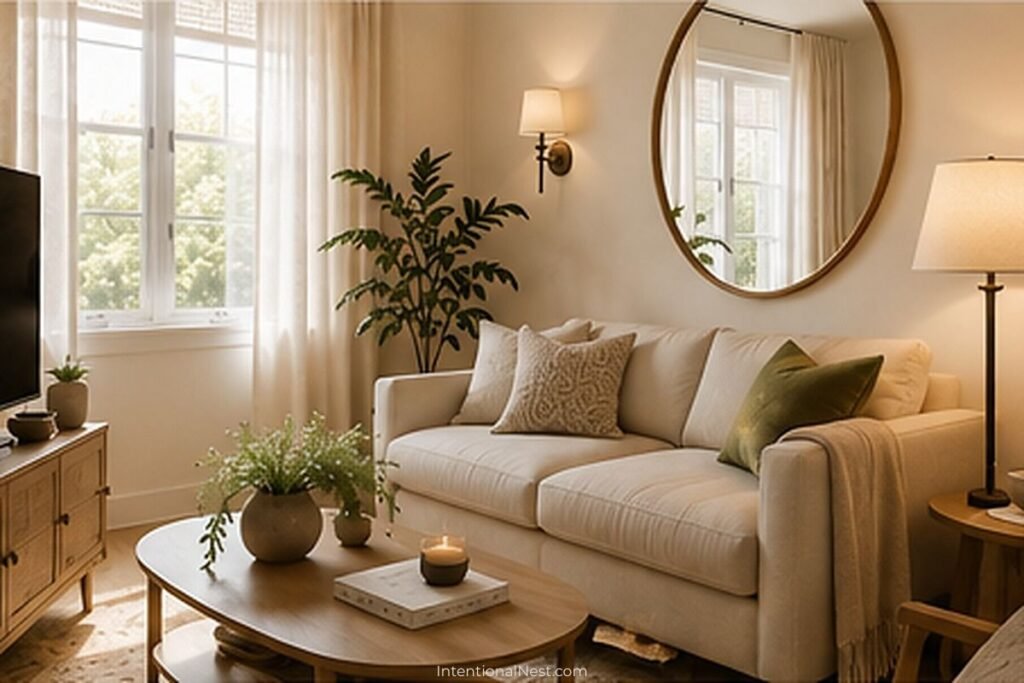
A connected color palette may include warm white walls, oatmeal upholstery, light oak furniture, muted sage pillows, and a few terracotta accents.
Each color is different, but they still feel like part of the same story.
You can create a calmer palette by:
- Choosing curtains close to the wall color
- Repeating one accent color two or three times
- Using similar wood tones
- Limiting the number of strong patterns
- Painting the walls and trim in the same color
- Adding texture instead of adding more colors
Texture is especially helpful in a neutral room.
Linen, woven baskets, boucle, wool, pale wood, and ceramic pieces add depth without making the room feel overly decorated.
A small living room does not need to be colorless. It simply benefits from a palette that feels intentional. Check out our color palette ideas here.
Product suggestions
Choose a simple mix of:
- Neutral curtain panels
- Two or three coordinating pillow covers
- A textured throw
- A light or medium wood side table
- Woven storage baskets
- Ceramic lamps or vases
- A tonal area rug
- One accent chair in a muted color
Pillow covers are one of the easiest ways to update the palette without replacing the entire sofa.
Try to avoid buying many small accessories in different colors. A few repeated tones will create a stronger and more finished look.
Suggested palette example:
- Warm white
- Oatmeal
- Light oak
- Muted sage
- Soft terracotta
7. Reduce Visual Clutter Without Removing Personality
A spacious living room does not have to be bare.
Books, art, plants, family photographs, and collected objects help a room feel personal. The challenge is giving those things enough space to be noticed.
When every shelf and tabletop is full, the eye has nowhere to rest.
Start with one surface.
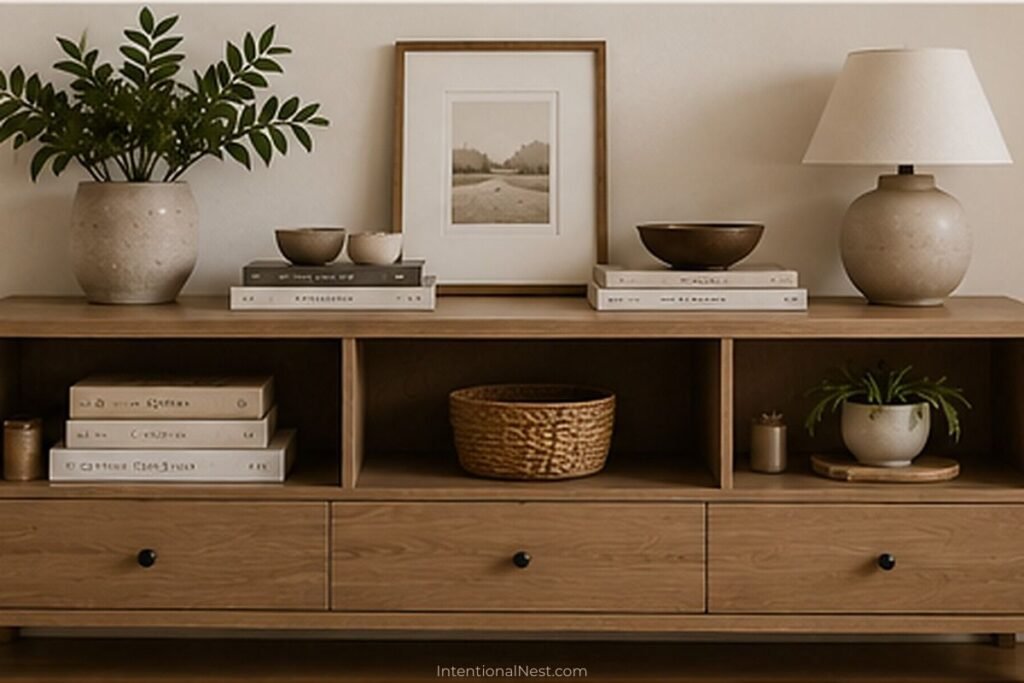
Clear the coffee table completely, then return only the pieces that are useful or beautiful. A book, a tray, and one decorative object may be enough.
Use the same approach with shelves.
Instead of spreading small objects across every surface, group them together. Leave some open space around each group.
A few larger pieces usually look calmer than many small accessories.
Closed storage is especially useful in a small living room. It gives everyday items a place to go without requiring you to keep everything perfectly styled.
Use closed storage for:
- Remote controls
- Chargers
- Toys
- Paperwork
- Extra cables
- Blankets
- Games
- Electronics
Baskets can also help, but each basket should have a clear job. Too many empty or decorative baskets can become another form of clutter.
Edit the artwork too
A gallery wall can look beautiful in a small living room, but it should feel connected.
Use consistent spacing, related colors, or similar frames to give the arrangement structure.
In some rooms, one larger piece of artwork creates a cleaner focal point than several small frames.
There is no single correct choice. The important thing is to avoid scattering unrelated artwork across every available wall.
Product suggestions
Helpful storage and styling products include:
- A low media console with doors
- A storage ottoman
- A lidded woven basket
- Decorative storage boxes
- A coffee table with drawers
- A floating cabinet
- A wall-mounted media unit
- A tray for small tabletop items
- Matching file boxes for paperwork
Choose storage that blends with the room rather than drawing attention to itself.
Before adding another accessory, ask yourself whether the room needs more detail or more breathing room.
A Simple Formula for a More Spacious Living Room
You do not need to make all seven changes at once.
Start with the areas that will make the biggest difference.
First, clear the main pathway through the room.
Next, improve the lighting and remove anything blocking the window.
Then identify the piece with the most visual weight. This may be a bulky chair, a dark coffee table, a crowded shelf, or a rug that is too small.
Once those larger issues are addressed, you can refine the room with better curtain placement, a connected color palette, and simpler styling.
A successful small living room should not only look bigger in photographs. It should also feel easier to move through, easier to maintain, and more comfortable to use every day.
The most inviting small rooms are not filled with decorating tricks. They are thoughtfully arranged, well lit, and edited with care.
Small Living Room Checklist
Use this checklist to decide what your living room needs most:
- The doorway and main pathway are clear
- Furniture does not block the window
- The sofa and chairs fit the scale of the room
- The main furniture has visible space underneath
- The rug connects the seating area
- Curtains are hung above the window frame
- Light reaches more than one part of the room
- The mirror reflects light or an attractive view
- The main colors repeat throughout the space
- Everyday clutter has a designated home
- Some shelves and surfaces remain intentionally empty
- Each piece of furniture serves a clear purpose
- The room still feels warm, personal, and comfortable
You do not need a large living room to create a home that feels open and inviting.
With a clearer layout, lighter furniture, better lighting, and a little more breathing room, even a compact living room can feel calm, comfortable, and beautifully put together.